# Is the Meta Pixel HIPAA Compliant? What Telehealth Brands Need to Know in 2026
> Is the Meta Pixel HIPAA compliant? Not on its own. What HHS guidance, the 2026 class certification and the FTC mean for telehealth, and what to check now.
Published 2026-11-06 · Last updated 2026-11-08 by Joe Michael, Founder & CTO, Kalman Analytics · https://kalmananalytics.com/blog/is-meta-pixel-hipaa-compliant/
If you've searched "is Meta Pixel HIPAA compliant" for a telehealth brand, the answer is: not on its own, and no setting makes it so. A pixel is a tool, not a status. The real question is what it sends to Meta from which pages, and whether Meta is covered to receive it. For a telehealth brand, the honest answer is usually "some of what it sends shouldn't go," and as of October 2026 a federal court has certified classes built around exactly that kind of data.
This post covers what HHS actually says, what changed in 2026, and the 20-minute check I'd run on any telehealth site before anyone tells legal the pixel is fine.
## The short answer: it depends on what the pixel sends
**Short answer:** the Meta Pixel isn't HIPAA compliant or non-compliant by itself. Under HHS guidance, the problem is a disclosure of protected health information (PHI) to a tracking vendor without a business associate agreement (BAA) and a valid permission. Meta doesn't offer a BAA for its ad tools, so the job is making sure PHI never reaches it.
Three facts frame everything else:
- **Meta won't be your business associate.** [Paubox](https://www.paubox.com/blog/facebook-pixel-hipaa-compliant) and [AccountableHQ](https://www.accountablehq.com/post/is-facebook-hipaa-compliant-in-2026-what-healthcare-providers-need-to-know) both say Meta doesn't sign BAAs, and Paubox found no change to that in 2026.
- **HHS requires a BAA before PHI goes to a tracking vendor.** Its [guidance on online tracking technologies](https://www.hhs.gov/hipaa/for-professionals/privacy/guidance/hipaa-online-tracking/index.html) says regulated entities must make sure tracking vendors have signed a BAA and that there's an applicable permission before any PHI is disclosed.
- **Cleaning it up after it arrives doesn't count.** The same guidance says a vendor promising to strip or de-identify PHI after receiving it is insufficient. That's worth remembering when someone says "Meta's core setup removes the URL anyway."
So "is the Meta Pixel HIPAA compliant" really means: does your pixel send PHI, from which pages, and could you prove it doesn't?
## What HHS says, and the part a court vacated
**Short answer:** HHS treats tracking on logged-in pages (patient portals, telehealth platforms) as generally having access to PHI. For public pages, a June 2024 court ruling vacated the part of the guidance saying an IP address plus a visit to a condition page triggers HIPAA. Pages that schedule care or handle login can still be in scope.
Most articles that rank for this question quote the HHS guidance without mentioning that part of it is no longer in force. Here's the current state, from the HHS page itself:
| Page type | What HHS says | Telehealth example |
| --- | --- | --- |
| Logged-in (authenticated) pages | Tracking "generally" has access to PHI; vendors are generally business associates and need a BAA | Patient portal, intake after account creation, visit room, refill requests |
| Login and registration pages | Count when a user enters credentials or registration details | "Create your account to start your visit" |
| Public pages that schedule care or check symptoms | May have access to PHI in certain circumstances | Booking widget, eligibility quiz |
| Other public condition pages | The part saying an IP address plus a visit triggers HIPAA was vacated on June 20, 2024 (*American Hospital Association v. Becerra*, N.D. Tex.) | "/weight-loss/semaglutide/" landing page |
HHS says it's "evaluating its next steps" on the vacated portion. Two more points from the guidance matter for marketers: a privacy policy disclosure alone doesn't permit a disclosure of PHI, and cookie banners aren't a valid HIPAA authorization. If the plan was "we added a consent banner," that's not a plan.
The vacatur is real, but read it narrowly. It took away one HHS theory about public pages. It didn't make condition pages safe to track, and it didn't touch the logged-in parts of a telehealth funnel, which is where intake, approvals and refills happen.
## What changed in 2026
Three things happened this year that change how I'd answer a client.
### 1. A court certified four classes in the main Meta Pixel healthcare case
On October 30, 2026, Judge William Orrick (N.D. Cal.) certified four classes of Facebook users in *In re Meta Pixel Healthcare Litigation*, the consolidated case filed in 2022 over the pixel on healthcare websites, according to [Cohen Milstein](https://www.cohenmilstein.com/meta-users-win-class-cert-in-pixel-healthcare-data-suit/) and [BankInfoSecurity](https://www.bankinfosecurity.com/judge-certifies-classes-in-meta-health-data-privacy-suit-a-33295). The judge rejected Meta's argument that the case was too individualized to proceed as a class. Meta disagrees with the ruling and says it will seek to appeal. There's no trial date, and nothing has been decided about whether Meta broke any law. This is a case against Meta, not against telehealth brands.
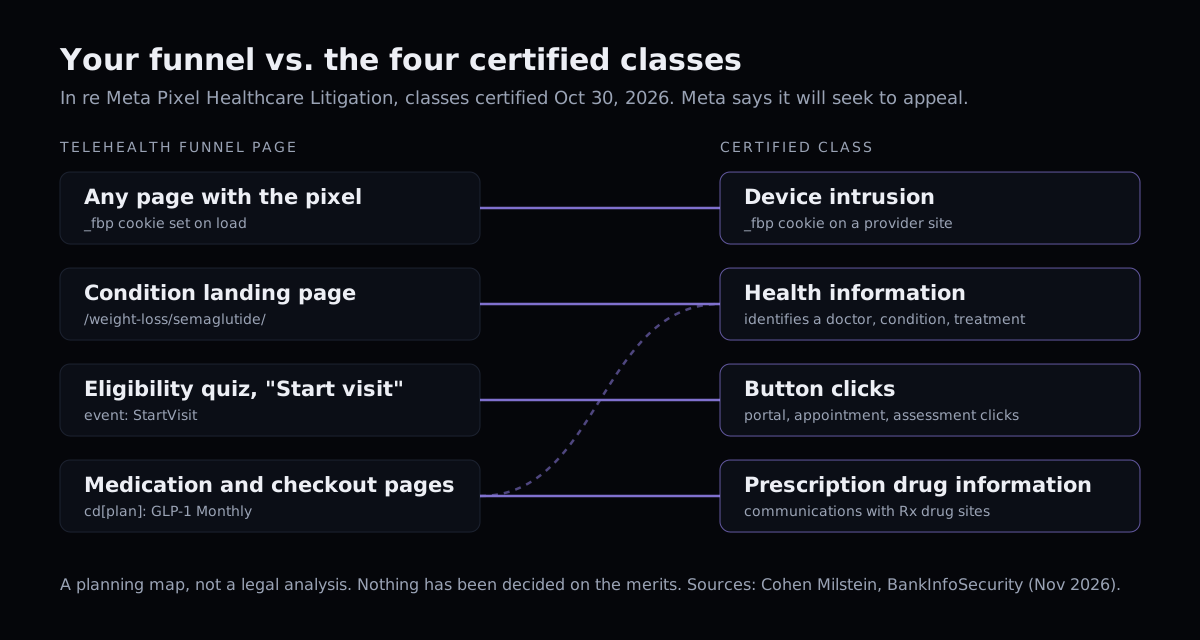
What's useful for a media buyer is how the classes are defined. Paraphrasing the reporting, they cover:
1. **Button clicks:** clicks on patient-portal, appointment, bill-payment or diagnostic-assessment buttons on provider sites.
2. **Health information:** data identifying a doctor, a condition or a treatment.
3. **Prescription drug information:** communications with prescription drug websites.
4. **Device intrusion:** people who had Meta's `_fbp` cookie set on a healthcare provider's site.
None of those requires a diagnosis to be sent. A click on "Start my visit" and a cookie on a provider site are enough to define a class. That's the shape of a normal telehealth funnel.
How the four certified classes line up with a typical telehealth funnel. A mapping for planning, not a legal analysis.
For contrast, in April 2026 a different judge in the same district *denied* class certification in the Meta Pixel tax-filing cases. Part of the reasoning, per [Holland & Knight](https://www.hklaw.com/en/insights/publications/2026/04/court-denies-class-certification-in-meta-pixel-case), was that generic data like IP addresses and URLs didn't necessarily reveal sensitive tax information. Telehealth URLs often do the opposite: `/trt/`, `/semaglutide/`, `/hair-loss/finasteride/`. (If you run a weight-loss funnel, [our GLP-1 ads tracking guide](/blog/glp-1-telehealth-ads-tracking/) maps every place the drug name can travel, including UTMs.)
### 2. An appeals court read "health information" broadly
On October 23, the Fifth Circuit reversed the dismissal of *Rand v. Eyemart Express*, a Meta Pixel case, and sent it back. [Duane Morris's summary](https://blogs.duanemorris.com/classactiondefense/2026/10/26/fifth-circuit-reverses-dismissal-of-adtech-class-action-on-narrow-grounds-finding-sufficient-factual-allegations-of-disclosure-of-phi/) says the court treated health information as broader than a diagnosis, reaching data relating to care or payment. It's a pleading-stage ruling, so it decides what a plaintiff can allege, not who wins.
### 3. The FTC acted on health data without HIPAA
On July 29, 2026, the FTC, Utah and California (through Los Angeles County Counsel) sued Hims & Hers. The [FTC's press release](https://www.ftc.gov/news-events/news/press-releases/2026/07/ftc-states-act-against-hims-hers-deceptive-unlawful-privacy-practices) alleges the company shared consumers' sensitive health information with advertising platforms, including Meta and Snap, through customer lists and tracking technologies that automatically shared site events. These are allegations; Hims [has moved to dismiss](https://www.claimsjournal.com/news/national/2026/10/26/340896.htm). The claims are under the FTC Act and state law. (We read the complaint as a media buyer [here](/blog/hims-hers-ftc-complaint-agency-checklist/).)
That last point is the one DTC telehealth teams miss. Whether HIPAA applies to your brand depends on how the business and its medical group are set up, and that's a question for counsel. But "HIPAA doesn't apply to us" doesn't end the conversation. Goodwin's [September 2026 analysis](https://www.goodwinlaw.com/en/insights/publications/2026/09/alerts-otherindustries-hltc-web-tracking-healthcare-data-regulation-enforcement-beyond-hipaa) covers how enforcement on web tracking runs well beyond HIPAA.
Scan your telehealth site free: https://kalmananalytics.com/scan
## Where the Meta Pixel leaks health information on a telehealth site
**Short answer:** in five places: page URLs and titles that name a condition or drug, button and event names, custom data parameters like plan or dosage, Advanced Matching that attaches hashed contact details to those pages, and the pixel running on logged-in pages at all. Most teams clean the checkout and leave the rest.
Here's a simplified event from a "Start my visit" click on a GLP-1 eligibility page. The identifiers are made up; the shape is what we typically see.
```text
What the pixel sends
event: StartVisit
dl: https://brand.example/weight-loss/semaglutide/eligibility?step=4
rl: https://brand.example/weight-loss/semaglutide/
cd[plan]: GLP-1 Monthly
em: (Advanced Matching)
fbp: fb.1.1730000000.123456789
What a compliant server-side event looks like
event: QualifiedVisit
value:
event_id:
(no URL, no plan name, no button text, nothing about the patient's condition)
```
Line the left side up against the certified classes: a click on an assessment-type button, a URL naming a prescription drug, a plan name that identifies a treatment, the `_fbp` cookie. Hashing the email doesn't change what the page says about the person. [AccountableHQ makes the same point](https://www.accountablehq.com/post/meta-pixel-in-healthcare-hipaa-compliance-privacy-risks-and-safer-alternatives): hashing isn't de-identification.
The right side is the goal. It still gives Meta a conversion to optimize on (the [signal ladder post](/blog/telehealth-signal-ladder/) covers how to choose that event), but it says nothing about the patient's condition.
## A 20-minute check before you answer legal
Do this for each brand and each pixel. Then [run the free Kalman scan](/scan) to check up to 15 public pages at once.
| Step | Where | What you're looking for |
| --- | --- | --- |
| 1. List every page the pixel loads on | Tag manager, site code | Anything behind login: portal, intake, visit room, refills. The pixel shouldn't be there. |
| 2. Walk the funnel with the network tab open | Browser, filter `facebook` | `dl` and `rl` values that name a condition, drug or quiz answer |
| 3. Read the event names | Same requests, Events Manager | Custom events like `QuizComplete_ED` or `StartVisit_TRT` |
| 4. Read the custom data | `cd[...]` parameters | Product, dosage, plan names |
| 5. Check Advanced Matching | Pixel settings, `em`/`ph` fields | Contact details attached on condition pages |
| 6. Check the server side | CAPI payloads, partner integrations | The same fields forwarded server-side ([why CAPI isn't a fix](/blog/does-capi-make-telehealth-tracking-safe/)) |
| 7. Check Meta's view | Events Manager settings | Your restriction level ([how to read it](/blog/meta-health-and-wellness-restrictions/)) |
Write down what you find, page by page. That record is what a lawyer will want, and it's what you'll need to show what changed after you fixed it.
## What to do instead of guessing
**Short answer:** keep the pixel off logged-in and intake pages, remove health detail from what's left, and send the conversions that matter server-side from a system you control, with an allowlist, a BAA with the vendor and a log of every field. Then rescan after every site change.
In order:
1. **Remove the pixel from everything behind login** and from intake steps that collect health answers.
2. **Clean public pages:** neutral slugs and titles, no treatment names in custom data, no condition-specific custom events, Advanced Matching off where the page names a condition.
3. **Move the conversions you optimize on server-side,** built from an allowlist so only the fields you've approved leave your systems. [Our telehealth conversion tracking guide](/blog/telehealth-conversion-tracking/) maps which events to send at each stage.
4. **Get it in writing:** a BAA with any vendor that touches PHI on the way to Meta.
5. **Rescan before every spend change.** A new landing page or quiz step can put a drug name back in a URL in an afternoon.
## Where Kalman fits
Kalman is built for this exact question. It connects to the telehealth stack (Stripe directly, and platforms like [Sylaris OS, Bask Health, Telegra and MDI](/integrations/)), turns outcomes like provider approval into a neutral event with a business value, and sends it to Meta server-side through an allowlist firewall: if a field isn't explicitly allowed, it doesn't leave. You see exactly what we send, and we sign a BAA with every customer.
Start with [the free scan](/scan). It checks up to 15 public pages, shows every tracker and what each one receives, and flags page addresses or titles that name a condition or medication, plus Advanced Matching on those pages. If you're comparing options, [see how Kalman compares](/compare/), or [see pricing](/pricing).
*This post is general information, not legal advice.*
## Frequently asked questions
### Is the Meta Pixel HIPAA compliant?
Not on its own. A pixel is a tool, not a compliance status. What matters is what it sends from which pages, and whether the recipient is covered by a business associate agreement. Meta doesn't offer one for its ad tools, according to Paubox and AccountableHQ, so a pixel that sends PHI to Meta is a problem under HHS guidance.
### Does Meta sign a BAA for the pixel or Conversions API?
Compliance guides that track this, including [Paubox](https://www.paubox.com/blog/facebook-pixel-hipaa-compliant) and [AccountableHQ](https://www.accountablehq.com/post/is-facebook-hipaa-compliant-in-2026-what-healthcare-providers-need-to-know), say no and found no change in 2026. Plan as if Meta will never be a business associate.
### Can I keep the Meta Pixel on public pages of a telehealth site?
HHS says many public pages don't involve PHI, and a 2024 court ruling vacated part of its guidance about public pages. But pages that schedule care, run a symptom checker or handle login can still be a problem, and a URL that names a drug tells Meta a lot. Scan the pages before you assume they're clean.
### Does moving to the Conversions API make the pixel HIPAA safe?
No. CAPI changes who sends the event, not what's in it. A server that forwards the same URL and product data is the same disclosure. More in [our CAPI post](/blog/does-capi-make-telehealth-tracking-safe/).
### What did the October 2026 Meta Pixel class certification decide?
On October 30, 2026, Judge William Orrick certified four classes of Facebook users in In re Meta Pixel Healthcare Litigation. It's a class certification, not a finding that Meta broke any law, and Meta says it will seek to appeal.
### If HIPAA doesn't apply to my telehealth brand, am I in the clear?
No. The FTC's July 2026 complaint against Hims & Hers is brought under the FTC Act and state law, not HIPAA. Those are allegations, but they show regulators don't need HIPAA to act on health data sent to ad platforms.
## Sources
- https://www.hhs.gov/hipaa/for-professionals/privacy/guidance/hipaa-online-tracking/index.html
- https://www.cohenmilstein.com/meta-users-win-class-cert-in-pixel-healthcare-data-suit/
- https://www.bankinfosecurity.com/judge-certifies-classes-in-meta-health-data-privacy-suit-a-33295
- https://www.hklaw.com/en/insights/publications/2026/04/court-denies-class-certification-in-meta-pixel-case
- https://blogs.duanemorris.com/classactiondefense/2026/10/26/fifth-circuit-reverses-dismissal-of-adtech-class-action-on-narrow-grounds-finding-sufficient-factual-allegations-of-disclosure-of-phi/
- https://www.ftc.gov/news-events/news/press-releases/2026/07/ftc-states-act-against-hims-hers-deceptive-unlawful-privacy-practices
- https://www.claimsjournal.com/news/national/2026/10/26/340896.htm
- https://www.paubox.com/blog/facebook-pixel-hipaa-compliant
- https://www.accountablehq.com/post/is-facebook-hipaa-compliant-in-2026-what-healthcare-providers-need-to-know
- https://www.accountablehq.com/post/meta-pixel-in-healthcare-hipaa-compliance-privacy-risks-and-safer-alternatives
- https://www.goodwinlaw.com/en/insights/publications/2026/09/alerts-otherindustries-hltc-web-tracking-healthcare-data-regulation-enforcement-beyond-hipaa