KLM-LOG Blog
Freshpaint Alternatives for Telehealth Brands (2026)
· Joe Michael, Founder & CTO · 11 min read
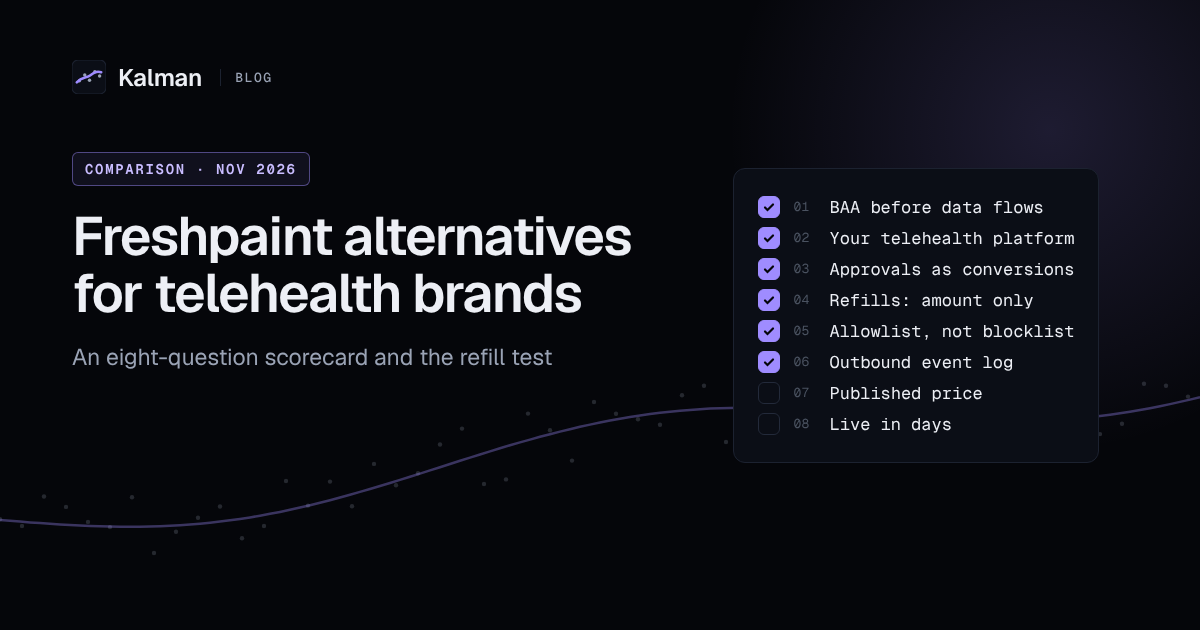
If you're looking for a Freshpaint alternative for a telehealth brand, most "alternatives" lists won't help much. They rank general customer data platforms on features and star ratings, and a few of the tools they list are email or customer-success software. None of the top results we read covers DTC telehealth: telehealth platforms, provider approvals, refills, or what Meta actually receives.
The short answer: Freshpaint is a broad healthcare marketing data platform, and if that's what you need, its closest swaps are other broad platforms such as Ours Privacy and Curve. If you're a DTC telehealth brand whose main channel is Meta, the question changes. Can the tool send your approvals and refills from your telehealth platform, with nothing health-related in the payload, and can it show you the payload? This guide gives you the scorecard, a 30-minute test, and a fair, sourced comparison, as of November 2026.
Disclosure: we build Kalman, one of the options below. Every fact about another vendor comes from that vendor's own public pages, which we read on November 9, 2026 and list under Sources. Where we write "not listed", we couldn't find it on those pages, which is different from saying it doesn't exist.
When Freshpaint is the right tool
Short answer: Freshpaint fits large healthcare organizations that want one platform for consent, governance, analytics, audiences and many destinations. If you run a hospital system, a payer or a multi-location provider with Epic, it was built for you, and an alternative should be judged against that breadth.
Here's what its own pages describe, as of November 2026:
- Breadth of integrations. Its integrations directory says it has more than 100, all covered by its BAA, so you don't negotiate one per tool. They include Meta (Pixel, Ads and the Conversions API), Google Ads, TikTok, Reddit, CallRail, HubSpot, Klaviyo, Epic MyChart and Experity.
- Consent. A consent manager with state-based opt-in and opt-out rules, enforced so opted-out tags stop firing. It has a section on DTC consent for companies HIPAA may not cover.
- More than tracking. Its plans (Comply, Perform and Scale) add audiences and DSP integrations, attribution and journeys, heatmaps and session replay, and an Ad Performance product on the top tier.
- A BAA. Its FAQ says it offers one, and that it doesn't collect the text people type into forms.
The tradeoffs a telehealth buyer will notice: prices aren't published (every plan says Talk to Sales), its virtual care page gives its own timeline as 3–6 weeks to implement, and we couldn't find Bask Health, Telegra, MDI or Stripe in its integrations directory. None of that is a flaw for a health system. It matters if you're a three-person growth team buying patients on Meta this quarter.
The telehealth scorecard: eight questions for any vendor
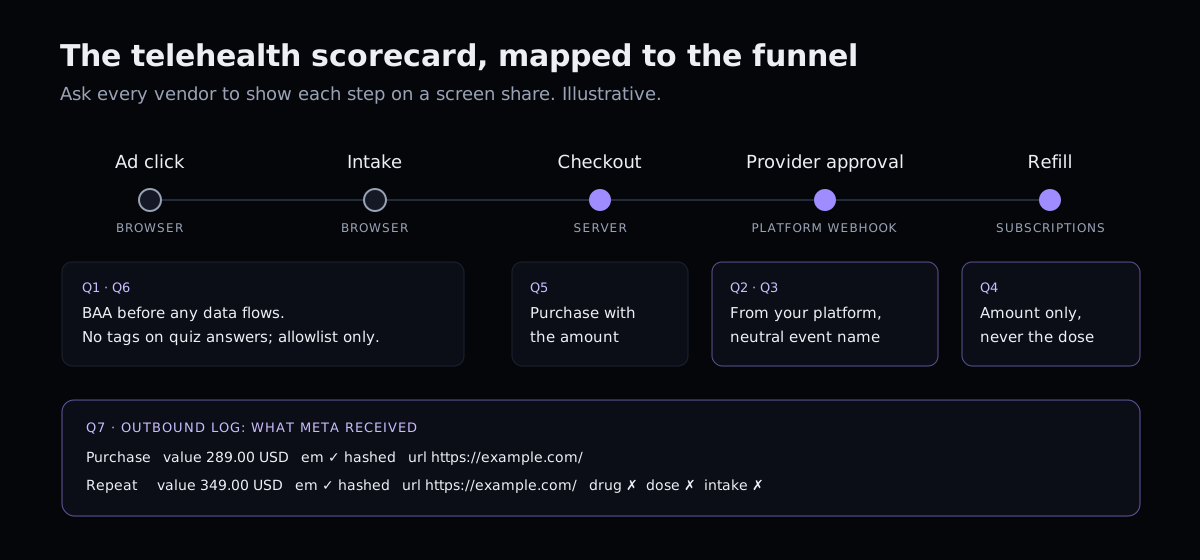
Short answer: ask every vendor the same eight questions, and ask them to answer with a screen share. These questions come from the telehealth funnel (ad, intake, checkout, provider decision, refills), not from a feature list.
| # | Question | Why it matters for telehealth | A good answer |
|---|---|---|---|
| 1 | Do you sign a BAA, on which plan, before data flows? | HHS says tracking vendors that receive PHI from regulated entities need a BAA | Yes, every plan, before setup |
| 2 | Which telehealth platforms do you connect to? | Approvals and refills live in Bask Health, Telegra, MDI, Sylaris OS or your own stack, not in the browser | Names your platform, native or by webhook |
| 3 | Can you send a provider approval as its own conversion? | An approved patient is worth more than a checkout, and many checkouts are declined | Yes, with a neutral event name |
| 4 | Can refills go to Meta with the amount and nothing else? | A refill that names the dose tells an ad platform about treatment | Yes, amount and currency only |
| 5 | What value does each conversion carry? | Meta's value optimization needs a real number | Order value or a lifetime value you control |
| 6 | Is the outbound payload an allowlist or a blocklist? | A blocklist misses the field someone adds next month | Allowlist: only approved fields leave |
| 7 | Can I read every event you sent, after the fact? | You'll need to show a client or counsel exactly what left | A searchable outbound log |
| 8 | What does it cost, and how long to go live? | Procurement time is campaign time | A published price and days, not months |
Questions 1 and 6 apply to any healthcare buyer. Questions 2 to 5 are where telehealth differs, and they're the ones the alternatives lists skip.
The options, one by one
Ours Privacy
Short answer: a healthcare CDP and privacy platform with a BAA on its entry plan, a web scanner on every tier, and testimonials from DTC and telehealth companies. Pricing is by monthly tracked users, through a demo.
Ours Privacy describes itself as a CDP and privacy platform for healthcare, built by healthcare marketers. Its pricing page has four plans (Essential, Core, Enterprise and Enterprise+), sized by monthly tracked users, with no dollar prices. The entry plan includes its BAA, Google Ads, Meta, GA4, one more destination and support for an external consent tool. Higher plans add CRMs, warehouses, an integrated consent manager, EHRs and an audience builder. A web scanner is on every tier, and its home page says basic setups take 2–3 days.
Real strengths: a fast start, many destinations, and a digital health page aimed at startups. What we couldn't find on the pages we read: Bask Health, Telegra or MDI, or approvals and refills described as conversions. Our Kalman vs Ours Privacy page has the full side-by-side.
Curve
Short answer: server-side ad tracking for healthcare organizations of every size, with a BAA on every plan, a free scanner and setup in about a week. Its telehealth integrations center on booking and intake tools.
Curve's home page describes server-side conversions to Meta, Google Ads, TikTok and Microsoft Ads. Its pricing is usage-based across Compliance, Growth and Enterprise plans, quoted on a call. A BAA is included on every plan, with a custom one on Enterprise, and consent banners are on Enterprise. Its telehealth page covers attribution through intake, booking and completed visits, and names tools like IntakeQ, Calendly, Acuity and Jane App, plus Healthie and Athenahealth through Keragon. Its free scanner checks a public URL against 75 tracking scripts.
Real strengths: a done-for-you setup and broad coverage of practice tools. What we couldn't find on the pages we read: Bask Health, Telegra, MDI or Stripe. See Kalman vs Curve.
A general CDP, or building it yourself
Short answer: Segment-style CDPs and server-side tag managers can route events anywhere. For a telehealth brand, that just moves the hard parts to you: the BAA, the allowlist, the approval and refill events, and the log.
Several alternatives lists put general CDPs at the top. They're capable tools. If you go this way, get three things in writing. First, does the vendor sign a BAA on your plan? HHS's tracking guidance says regulated entities need one with tracking vendors that receive PHI. Second, who writes and maintains the field allowlist for each destination? Third, who builds the webhook from your telehealth platform and keeps it working? Building it yourself on your own cloud is also an option. You then own all three for good.
Kalman
Short answer: Meta tracking built for DTC telehealth brands and their agencies. It sends approvals and refills from your telehealth platform, builds every event from an allowlist, logs everything it sends, and publishes its prices. It's narrower than the platforms above, on purpose.
Kalman takes outcomes from where they happen: Sylaris OS natively, Bask Health, Telegra and MDI through a webhook, and Stripe directly. It sends them to Meta server-side as neutral events with a value. Every outbound event is built from an allowlist: event name, time, value, hashed identifiers, click IDs and your site root. Every delivery is written to an outbound log you can read. We sign a BAA with every customer, on every plan, before any data flows. Meta is on every plan. Other ad platforms are on Signal + Attribution, and pricing is published.
What it isn't: a consent manager (it works with the one you have), a data warehouse pipeline, or an EHR integration for a health system. If you need those from one vendor, the platforms above cover more ground. See Kalman vs Freshpaint for that comparison in detail.
Side by side, as of November 2026
| Freshpaint | Ours Privacy | Curve | Kalman | |
|---|---|---|---|---|
| Built for | Healthcare marketers broadly, including health systems and virtual care | Healthcare marketing teams, including digital health | Healthcare organizations of every size | DTC telehealth brands on Meta, and their agencies |
| BAA | Offered | Entry plan; custom above | Every plan; custom on Enterprise | Every customer, every plan |
| Published prices | No (three plans, Talk to Sales) | No (four plans by tracked users) | No (usage-based, book a call) | Yes |
| Telehealth platforms (Bask Health, Telegra, MDI) | Not listed | Not listed | Not listed | Webhook today; Sylaris OS native |
| Approvals and refills as conversions | Not described | Not described | Completed visits and bookings | Yes, with a value |
| Consent manager | Yes, state-based | Enterprise; external tool on entry | Enterprise | Works with yours |
| Free scan | Web tracker report | Web scanner on every tier | Free compliance scanner | Free scan, no call |
| Stated setup time | 3–6 weeks | 2–3 days for basic setups | About a week | Done with you, one tag and one webhook |
| Breadth beyond ads | Widest: audiences, DSPs, warehouses, session replay | Wide: CRMs, warehouses, EHRs, A/B testing | Call tracking, session replay, heatmaps | Narrow: Meta signal plus first-party funnel analytics |
The 30-minute test: ask for the refill
Short answer: during the demo, ask the vendor to send one test refill from your telehealth platform to Meta's Test Events tool, then show you the exact payload. That one test covers questions 2, 4, 6 and 7 from the scorecard.
Here's what a refill often looks like when a platform webhook is forwarded as-is:
{
  "type": "subscription.renewed",
  "patient": { "email": "[email protected]", "phone": "+13035550142" },
  "plan": "Tirzepatide 5mg monthly, step 2",
  "intake": { "weight_lb": 214, "goal": "lose 40 lb" },
  "landing_url": "https://northwindhealth.com/weight-loss/tirzepatide/",
  "amount": 349.00
}
And here's what Meta should receive instead:
{
  "event_name": "Repeat",
  "event_time": 1794240000,
  "event_id": "sub_7QK2-r3",
  "action_source": "website",
  "event_source_url": "https://northwindhealth.com/",
  "user_data": { "em": ["a1f9…e07c"], "ph": ["5c3b…91d2"] },
  "custom_data": { "value": 349.00, "currency": "USD" }
}
Run through it with the vendor:
| Check | Pass |
|---|---|
| The event came from your telehealth platform, not the browser | Yes |
| The event name is neutral | Repeat, not Tirzepatide_Refill |
| The URL is your site root | No path or query string |
| Email and phone are hashed | Never plain text |
| Drug, dose, plan name and intake answers | Absent |
| The vendor can show this event in a log tomorrow | Yes |
If the vendor can't run this in a demo, you've learned something important before signing a contract. For the full event model, see our telehealth conversion tracking guide, and for GLP-1 funnels, the GLP-1 tracking field guide.
Before you switch: three things no tool fixes
Short answer: a new tool changes how data leaves your site, not whether you're allowed to advertise, what your ads say, or which law applies to you. Check these three alongside the vendor decision.
- Whether you can run prescription drug ads at all. Meta's drugs and pharmaceuticals standard requires online pharmacies and telehealth providers promoting prescription drugs to be actively LegitScript certified and then authorized by Meta. Ads can target only people 18 and over, in the US, Canada or New Zealand. Ads that promote telehealth services in general don't need that authorization.
- Which rules apply to you. Many DTC brands aren't HIPAA covered entities. That doesn't mean no rules apply. The FTC's guidance says the FTC Act covers health information either way. It also says disclosing health information for advertising without affirmative express consent may be an unfair practice. Our Meta Pixel and HIPAA explainer walks through what HHS still says after the 2024 court ruling.
- What's already on your site. Switching vendors doesn't remove old tags. Before and after a migration, scan your site and check that the old pixel is gone from intake, checkout and login pages. Our Meta health and wellness restrictions guide shows how to read your restriction level in Events Manager.
A switching checklist
| Step | What to do |
|---|---|
| 1. Baseline | Export a week of the events Meta receives today, by event name and count |
| 2. BAA first | Sign the new vendor's BAA before any data flows |
| 3. Shadow run | Send the new tool's events to Test Events or a shadow destination, not live, for a few days |
| 4. Compare | Match counts and values against the baseline; investigate any gap over a few percent |
| 5. Keep IDs stable | Use one event_id scheme so Meta deduplicates during the overlap |
| 6. Cut over | Switch the live Meta destination, then remove the old tags and server connection |
| 7. Re-scan | Run a scan to confirm the old tags are gone from sensitive pages |
Kalman's shadow mode and signal-gap report do steps 3 and 4 for you. With any vendor, don't skip them.
The bottom line
Freshpaint is a strong choice for large healthcare organizations that want one platform for everything. Ours Privacy and Curve are the closest broad alternatives, with faster starts. If you're a DTC telehealth brand and Meta is your main channel, choose the tool that passes the refill test. That means your platform, your approvals and refills, an allowlist, and a log you can read.
Start with what your site sends today. Run the free scan: it takes about a minute, needs no call, and shows which trackers load on your public pages and what each one receives. Then compare plans.
This post is general information, not legal advice. Vendor details are as of November 2026 and change; check each vendor's pages before you buy. Something out of date? Email [email protected] and we'll correct it.
Frequently asked questions
What is the best Freshpaint alternative for a telehealth brand?
It depends on the job. For a health system that needs many destinations, a consent manager and EHR connections, a broad healthcare data platform such as Ours Privacy or Curve is the closer swap. For a DTC telehealth brand whose main channel is Meta, pick the tool that can send your approvals and refills from your telehealth platform, with a payload you can read. Run the 30-minute refill test in this post before you sign.
Does Freshpaint publish its prices?
No. As of November 2026, Freshpaint's pricing page lists three plans (Comply, Perform and Scale), each with a Talk to Sales button. Ours Privacy and Curve also quote by demo or call. Kalman's prices are on its pricing page.
Do Freshpaint alternatives sign a BAA?
The healthcare-focused ones say they do. Freshpaint's FAQ says it offers a BAA, Ours Privacy includes its BAA on its entry plan, Curve says a BAA is included on every plan, and Kalman signs one with every customer before any data flows. General-purpose CDPs vary, so ask which plan includes it.
My telehealth brand isn't a HIPAA covered entity. Do I still need this?
Probably. The FTC says the FTC Act applies to health information whether or not HIPAA does, and that sharing it for advertising without affirmative express consent may be unfair. Its Health Breach Notification Rule can also apply to companies HIPAA doesn't cover. Ask your counsel which rules apply to you.
Can I switch from Freshpaint without losing conversion data?
Yes, if you run both side by side first. Send the new tool's events in a test or shadow setup, compare them against what Meta receives today, then switch the Meta destination over and remove the old one. Keep one event ID scheme throughout so Meta doesn't double count.
Sources
Free scan
Scan your telehealth site free.
See what your site sends to ad platforms today, and what to fix first. Ready to fix it? See pricing.
Scan your site free